In the message to the church in Philadelphia in the Book of Revelation, the faithful believer who “conquers” is promised a great honor. He will become like a pillar in the temple of God. On this pillar, three names will be written: the name of God, the name of the city of God (the new Jerusalem), and the new name of Christ.
These three names have deep symbolic meaning. In ancient times, writing a name on a building or pillar showed ownership and belonging. Here, the names show that the faithful person belongs completely to God. The name of Jerusalem refers not to the earthly city, but to the heavenly Jerusalem. This is the final vision described by St John in the Book of Revelation The Jewish Community in Laodicea.
In this vision, the heavenly city comes down from heaven like a bride beautifully prepared for her husband. It represents the ultimate hope of believers: eternal life in the presence of God. Those who remain faithful through suffering and difficulty will become citizens of this new and perfect city.
The names written on the pillar are also understood by some scholars to mean “God has established his house with strength.” This idea connects again to the image of pillars in Solomon’s Temple, which symbolized stability and divine power. In the same way, faithful believers are promised a secure and everlasting place in God’s kingdom.
Ancient Laodicea
Foundation of the City
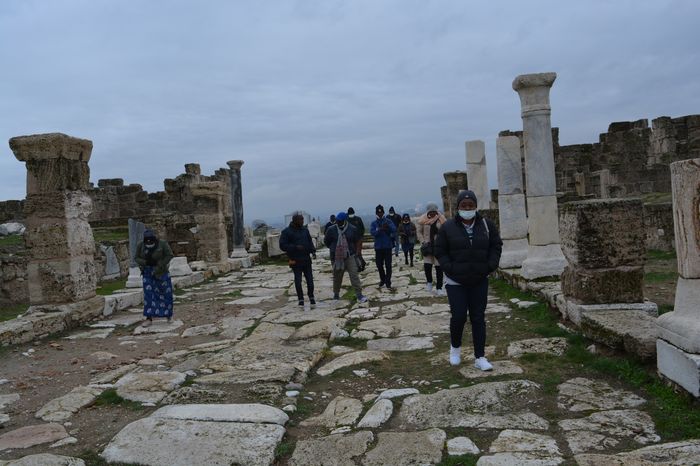
Ancient Laodicea on the Lycus, known today as Eskihisar, was founded by the Seleucid king Antiochus II Theos, who ruled between 261 and 246 BCE. He named the city after his wife, Laodice. Because there were several cities with the same name, this one was called “Laodicea on the Lycus,” after the nearby Lycus River (today called Çürüksu) City Tours Istanbul.
The Lycus River was a tributary of the larger Meander River. Its waters helped make the region rich in agriculture. The fertile land supported farming, trade, and economic growth. As usual in the Hellenistic period, the city was founded in a strategic place. It stood on an important trade and military route that connected the Aegean coast with the interior of Anatolia.
Political and Military Importance
The main purpose of founding Laodicea was probably political and military. Antiochus II wanted to strengthen his control over western Anatolia. The city stood on a key communication and trade route, and it could serve as a defensive stronghold. At that time, the Seleucid kingdom faced pressure from its northern enemies, especially the Antigonid rulers of Macedon. Establishing a strong city in this area helped protect Seleucid interests.
The early population of Laodicea likely included local native people, Greek settlers who had adopted Hellenistic culture, and veteran soldiers from the army of Antiochus II. This mixture of people gave the city both cultural diversity and military strength.
From Seleucid to Roman Rule
In 190 BCE, the Seleucid Empire was defeated by Rome at the Battle of Magnesia. After this defeat, much of western Anatolia was taken from the Seleucids. The region, including Laodicea, was given to Eumenes II of Pergamum as a reward for supporting Rome in the battle.
Later, in 133 BCE, Attalos III, the last king of Pergamum, left his kingdom to Rome in his will. As a result, Laodicea became part of the Roman Empire, together with the rest of western Anatolia.
Under Roman rule, the city continued to grow and prosper. Its location on major trade routes helped it become an important commercial center. The fertile lands and flowing rivers of the region continued to support its economic strength.
Both the vision of the heavenly city in Revelation and the history of Laodicea show how closely religion, politics, and geography were connected in ancient Anatolia. While the Book of Revelation speaks of a spiritual and eternal city, Laodicea was a real and powerful city built for trade, defense, and political control. Its history reflects the changing powers of the ancient world, from the Seleucids to Pergamum and finally to Rome.